Xishuangbanna Travel Guide: Rainforests, Elephants & Dai Culture in China's Tropical South
When most people picture China, they imagine ancient temples, misty mountains, or neon-lit megacities. A tropical rainforest rarely makes the list. Xishuangbanna dismantles that assumption entirely.
Here, palm trees line the streets, wild Asian elephants roam protected valleys, golden Buddhist stupas rise above Dai villages, and the Mekong River — known locally as the Lancang — winds its way south toward Laos. The air is thick and warm year-round. The food tastes closer to northern Thailand than to Beijing. And the rhythm of life follows a different clock altogether.
Xishuangbanna sits at the southernmost tip of Yunnan Province, sharing borders with Laos and Myanmar. It is the only place in China where intact tropical rainforest ecosystems still exist — and for travelers willing to look beyond the country's more obvious destinations, it is one of the most rewarding places on the map. This guide covers everything you need to plan your trip: where to go, what to do, when to visit, and how to get there.
Where Is Xishuangbanna?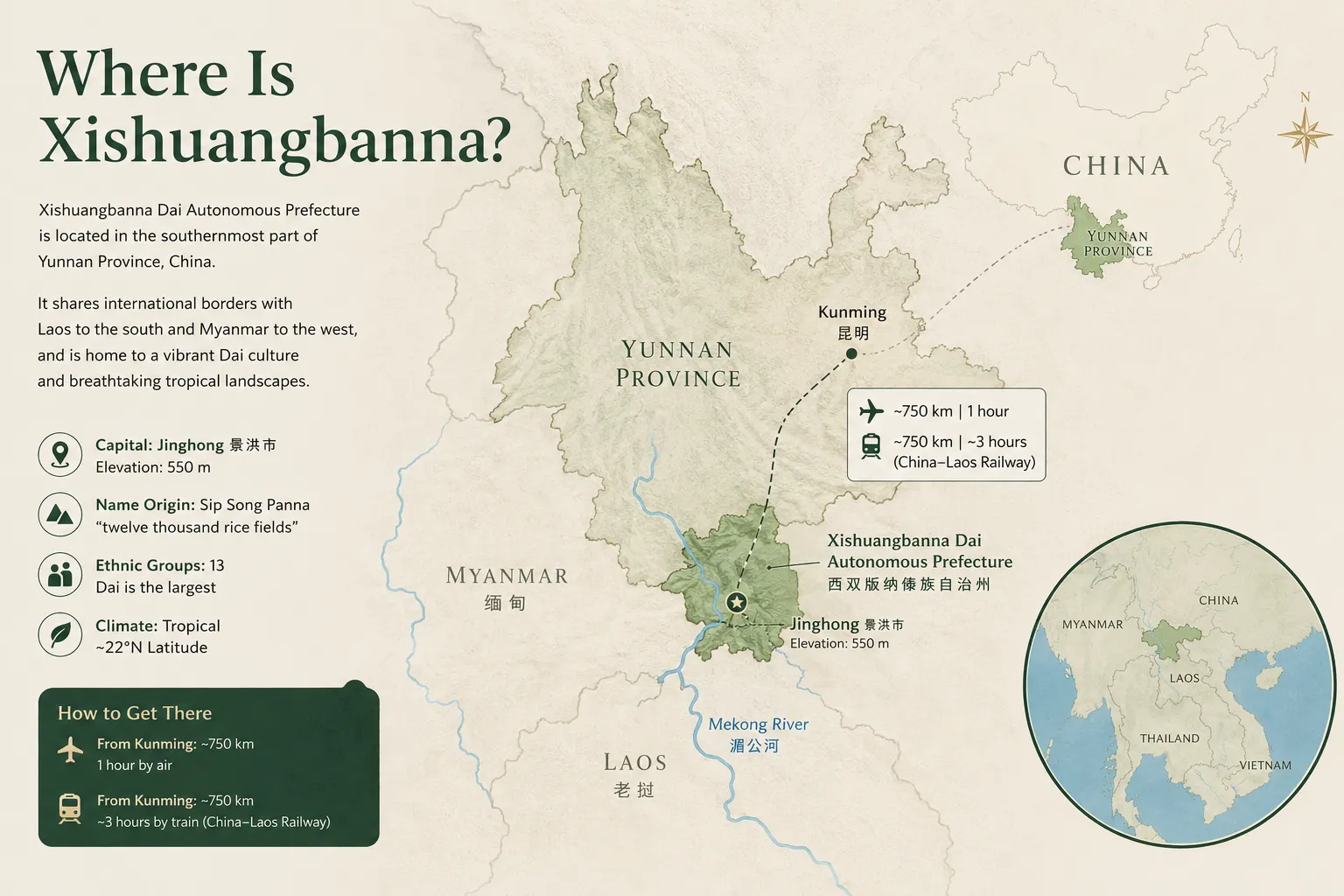
Xishuangbanna — officially the Xishuangbanna Dai Autonomous Prefecture — occupies the southernmost corner of Yunnan Province in southwestern China. It shares international borders with Laos to the south and Myanmar to the west, and its capital city, Jinghong, sits on the banks of the Mekong River at an elevation of just 550 meters above sea level.
The name itself comes from the Dai language: Sip Song Panna, meaning "twelve thousand rice fields" — a reference to the ancient administrative divisions of the region and a reminder that this place has its own linguistic and cultural identity entirely distinct from Han Chinese civilization.
The geography explains why Xishuangbanna feels so different from anywhere else in China. At roughly 22 degrees north latitude, it sits within the tropics, giving it a climate far closer to Southeast Asia than to the Chinese interior. The terrain is defined by river valleys, forested hills, and a biodiversity corridor that connects the ecosystems of southern China with those of mainland Southeast Asia. Roughly 13 ethnic minority groups call the region home, of which the Dai people are the largest and most culturally visible.
From Kunming, Xishuangbanna is about 750 kilometers south — one hour by air, or around three hours by train on the China-Laos Railway. From the moment you arrive, it is clear you have crossed into a different world.
Xishuangbanna's Natural World: Rainforests & Wild Elephants
Xishuangbanna contains the only intact tropical rainforest in China — a fact that alone makes it worth the trip for nature travelers. The prefecture falls within one of the most biodiverse regions in Asia, home to more than 5,000 plant species, over 100 mammal species, and roughly a third of China's bird species. What follows are the key natural sites.
Wild Elephant Valley (野象谷)
This is the single most visited natural attraction in Xishuangbanna, and for good reason: it is the only place in China where you can reliably observe wild Asian elephants in their natural habitat. The valley contains a 4,000-meter elevated boardwalk that runs through primary rainforest, allowing visitors to observe the elephants from above without disturbing them.
The Asian Elephant Museum on site provides essential context on the conservation challenges facing the species. China's wild elephant population numbers around 300, the majority of which live in Xishuangbanna. Sightings are not guaranteed, but the valley's management has created monitoring systems and natural corridors that make encounters more consistent than anywhere else in the country. Early morning visits offer the best chances.
Xishuangbanna Tropical Botanical Garden (西双版纳热带植物园)
Managed by the Chinese Academy of Sciences and rated as a 5A national scenic area — China's highest designation — this botanical garden in Mengla County is one of the largest and most scientifically significant in Asia, housing more than 13,000 plant species across several hundred hectares. It is as much a living research institution as a visitor destination.
For travelers, the garden offers a rare chance to walk through intact lowland tropical forest, encounter plants that exist nowhere else in China, and understand the ecological logic of a rainforest at ground level. Allow at least half a day, and visit in the morning before the midday heat sets in.
Canopy Walkway at Wangtian Tree Scenic Area (望天树)
The wangtiangshu — literally "sky-gazing trees" — are a species of giant tropical hardwood that can reach 70 meters in height, forming one of the most visually dramatic landscapes in the region. A suspended canopy walkway between the treetops gives visitors a bird's-eye view of the rainforest, with the forest canopy spreading in every direction below. It is genuinely unlike anything else accessible in China.
Dai Culture: Temples, Villages & the Water Splashing Festival
The Dai people share cultural, linguistic, and religious ties with the Thai, Lao, and Shan peoples of Southeast Asia. Theravada Buddhism is the dominant faith, and its influence is visible everywhere: in the white-and-gold stupas that punctuate the skyline, in the monks who walk through village markets in saffron robes each morning, and in the festivals that structure the year.
Manting Park (曼听公园)
Located in central Jinghong, Manting Park is the cultural heart of the Dai world in Xishuangbanna. The park contains several active temples, traditional performance spaces, and gardens that have been tended for centuries. Evening performances of Dai dance — including the famous peacock dance — are staged regularly and offer a genuine, if curated, introduction to the region's performing arts traditions.
Dai Ethnic Park (傣族园)
About 27 kilometers from Jinghong, the Dai Ethnic Park encompasses five intact Dai villages whose architecture, lifestyle, and religious practice have been preserved largely as they existed generations ago. The bamboo stilt houses (吊脚楼), village stupas, and hand-woven textile traditions are all accessible to visitors. Staying overnight within the park — in a traditional Dai bamboo house — offers an immersive experience that no city hotel can replicate.
Water Splashing Festival (泼水节)
Held each year in mid-April, the Dai New Year celebration — known across Southeast Asia as Songkran — reaches its most exuberant expression in Xishuangbanna. For three days, the streets of Jinghong become a continuous water festival, with tens of thousands of participants drenching each other in what is simultaneously an ancient purification ritual and a full-scale public celebration.
It is one of the most spectacular festivals in China. It is also one of the most logistically demanding to attend: hotels book out weeks in advance, prices rise sharply, and the city's population multiplies several times over. If you plan to attend, begin looking for accommodation at least four to six weeks ahead.
Dai Food
The cuisine of Xishuangbanna is one of the most distinctive in China, with almost no overlap with the flavors most visitors associate with Chinese food. Sticky rice (糯米饭) replaces steamed rice as the staple. Lemongrass-grilled chicken (香茅草烤鸡) is the signature dish. Grilled river fish wrapped in banana leaves, pineapple rice served inside a hollowed fruit, and an extensive range of wild herbs and jungle vegetables round out a food culture that is unmistakably Mekong in character. The night market in central Jinghong is the best single place to eat your way through it.
Best Things to Do in Xishuangbanna
Beyond the headline attractions, Xishuangbanna rewards slower and more spontaneous exploration. Here is a practical guide to experiences worth building into your itinerary.
Rainforest hiking — Several trails around the Botanical Garden and Menglun area allow independent trekking through primary forest. Early morning starts are essential to avoid heat and maximize wildlife activity.
Cycling along the Mekong — A well-established cycling route follows the Lancang River south from Jinghong through Dai villages, rubber plantations, and small Buddhist monasteries. The relatively flat terrain and continuous riverside scenery make it one of the most enjoyable half-day rides in Yunnan.
Jinghong Night Market — The evening food market in central Jinghong is the social and culinary center of the city after dark. Grilled meats, tropical fruits, freshly pressed juices, and local snacks are available at low prices in a lively but accessible atmosphere.
Pu-erh tea estate visit — Xishuangbanna, alongside neighboring Pu'er, is the historical heartland of Pu-erh tea production. Several estates in Menghai County offer guided visits covering the full process from fresh leaf to pressed cake, with tastings of both raw and aged varieties. It is a worthwhile half-day even for travelers who don't think of themselves as tea enthusiasts.
Dai batik and textile workshops — Traditional tie-dye (扎染) and hand-weaving workshops operate in the Dai Ethnic Park and several village studios around Jinghong. The techniques have been practiced for centuries, and the resulting textiles are among the best craft souvenirs available anywhere in Yunnan.
Sunrise on a Menghai tea mountain — The tea-growing hills of Menghai County are at their most beautiful in the early morning, when mist fills the valleys between terraced gardens. The drive before dawn is worth the effort.
Mohan border day trip — The Mohan–Boten border crossing into Laos is approximately 250 kilometers south of Jinghong. The journey through increasingly remote Dai and Bulang villages is the main event, with the crossing itself offering a vivid sense of how thin the boundary is between Xishuangbanna and the world beyond.
Best Time to Visit Xishuangbanna
Xishuangbanna has two distinct seasons, each with a different character and a different kind of appeal.
Season | Months | Conditions |
Dry Season | November – April | Clear skies, low humidity, 20–30°C, ideal for most activities |
Wet Season | May – October | Heavy tropical rainfall, lush vegetation, significantly fewer crowds |
Water Splashing Festival | Mid-April | Peak crowds and prices, advance booking essential |
November through February is the most comfortable window for most visitors. Temperatures hover between 20 and 28 degrees Celsius, humidity is manageable, and the light is clear. This is the peak season for good reason, and when the full range of outdoor activities is most accessible.
March and April remain dry but grow progressively hotter. If the Water Splashing Festival is your primary reason for visiting, plan around it carefully — the city transforms completely for three days and then returns to normal with equal speed.
The wet season (May through October) brings heavy afternoon rainstorms but also brings the rainforest to its most alive state: denser vegetation, more active wildlife, dramatic cloud formations over the valley, and almost no other tourists. If experiencing the natural environment at its most raw is your priority, the rainy season makes a genuine case for itself. Pack waterproof layers, adjust your expectations, and enjoy having the trails largely to yourself.
Most recommended window for first-time visitors: November through February.
How to Get to Xishuangbanna
By air — Jinghong Gasa International Airport (JHG) receives direct flights from Kunming (approximately 1 hour), Chengdu (approximately 2 hours), Guangzhou, Shenzhen, and several other major Chinese cities. The airport sits about 5 kilometers from the city center, easily reached by taxi or ride-hailing app.
By train — The China-Laos Railway, which opened in 2021, has transformed overland access to Xishuangbanna. Trains run between Kunming South Station and Mohan in approximately 3 hours, with a stop serving Jinghong. This is now the most scenic way to arrive: the line descends through the mountains and river valleys of southern Yunnan, crossing dozens of bridges and tunnels as the landscape transitions from temperate highland to subtropical lowland. For travelers who want the journey to feel like part of the experience, the train is the clear choice.
By road — The drive from Kunming takes approximately 6 to 7 hours via expressway and mountain road, passing through Pu'er and Simao. It is a beautiful route but a long one, best suited to travelers with their own vehicle or those making planned stops along the way.
Getting Around Xishuangbanna
Within Jinghong, the city is compact and manageable. Ride-hailing apps (Didi) work reliably, electric scooter rentals are available throughout the center, and bicycles can be hired from most hotels and guesthouses for short-distance trips.
Between major attractions, public buses connect Jinghong with the Botanical Garden, Wild Elephant Valley, and the Dai Ethnic Park on fixed schedules throughout the day. For more flexibility — particularly if you want to reach smaller villages, tea-growing areas in Menghai, or more remote sections of the river — hiring a private driver for the day is a practical and reasonably affordable option.
The cycling route along the Mekong is flat and well-marked. Most rental shops in central Jinghong offer road or hybrid bikes for half-day or full-day hire.
Where to Stay in Xishuangbanna
Jinghong city center offers the widest range of accommodation at every price point, the easiest access to restaurants and the night market, and the most convenient base for day trips. Most first-time visitors will find this the most practical choice.
Dai Ethnic Park — Staying inside the park in a traditional bamboo stilt house is the most immersive accommodation option in Xishuangbanna. Waking up inside a working Dai village, with temple bells in the morning and fireflies after dark, is a genuinely different category of experience from a city hotel. Book directly with park guesthouse operators rather than through third-party platforms.
Around the Botanical Garden (Mengla/Menglun area) — For travelers whose priority is the natural environment rather than city convenience, guesthouses near the Botanical Garden provide a quieter base with direct access to the best forest environments in the region.
Luxury resorts — Xishuangbanna has attracted serious international hospitality investment. Aman and Anantara both operate properties in the prefecture, offering pool villa accommodations within tropical garden settings whose architecture and landscaping integrate thoughtfully with the surrounding environment. For travelers seeking a high-end base, either property is a genuine match for the destination.
Experience Xishuangbanna by Train: The Silk Road Express
Most travelers fly in and fly out of Xishuangbanna — it is the fastest option, and for a short trip it is often the only practical one. But there is a way to arrive that makes the journey itself worth remembering long after the destination fades.
The Silk Road Express, operated by Glamour Trains (星享铁旅), runs three Yunnan-series itineraries that each pass through Xishuangbanna — treating the region not as an endpoint to reach, but as a turning point in a longer journey through the province.
All three routes operate over four days and three nights, with Xishuangbanna as the shared centrepiece. What changes is where the journey begins, and where it goes next:
Route A — Impressions of Southern Yunnan: Sipsongpanna & Shiping
Departing from Chengdu, this route crosses from Sichuan into Yunnan and arrives in Xishuangbanna before continuing east to Shiping — a lesser-known Yunnan town with remarkable Ming-dynasty heritage and a completely different cultural register from the tropical south. The journey ends in Kunming. For travelers coming from Sichuan, this is the most complete single route for experiencing Yunnan's contrasts in one pass.
Route C — Tea, Cangshan & Erhai: Sipsongpanna & Dali
Beginning in Kunming, this route heads south into Xishuangbanna before turning northwest toward Dali — one of Yunnan's most beloved destinations, set between the Cang Mountains and Erhai Lake. The return completes in Kunming. This itinerary pairs the tropical south with the ancient lakeside culture of western Yunnan in a single continuous arc, covering two of the province's most distinct environments without retracing a single kilometer.
Route D — Tracing the Dian-Yue Trail: Sipsongpanna & Hekou
Departing from Kunming, this route descends south through Xishuangbanna and continues to Hekou — the Red River border town where Yunnan meets Vietnam. The return closes back in Kunming. It is the most frontier-oriented of the three, passing through some of the most remote and scenically layered terrain in the province, and ending at one of China's most historically charged southern border crossings.
The train's onboard experience operates at a level uncommon in Chinese rail travel: private accommodations with considered design, dining that reflects the regional food culture of each leg, and a pace that gives you time to understand the landscape changing outside the window before you step into it. The descent through the gorges and forested ridges of southern Yunnan — arriving finally into the flat, humid warmth of Xishuangbanna — is one of the most visually complete arrivals available anywhere in China.
→ View full itineraries, departure dates, and cabin options on the Glamour Tains Website.
FAQ: Everything You Need to Know Before You Go
Is Xishuangbanna worth visiting?
Yes — and particularly so for travelers who feel they have already seen China's most obvious destinations. Xishuangbanna offers a combination of tropical rainforest, living ethnic minority culture, Buddhist heritage, and border-region food that exists nowhere else in the country. It does not feel like the rest of China, which is precisely why it is worth going.
How many days do you need in Xishuangbanna?
A minimum of three full days allows you to cover the main natural and cultural sites: Wild Elephant Valley, the Botanical Garden, Dai Ethnic Park, and Jinghong's night market. Five days gives you enough time to add a tea mountain visit, a Mekong cycling day, and a slower pace overall. A week is not too long if you are interested in exploring the more remote villages and border areas of Menghai and Mengla counties.
Can you see wild elephants in Xishuangbanna?
Yes — Wild Elephant Valley (野象谷) is the most reliable place in China to observe wild Asian elephants. The reserve's elevated boardwalk allows visitors to watch the elephants from above without disturbing them, and the site's monitoring team tracks herd movements to improve visitor sighting rates. That said, these are genuinely wild animals and sightings are never guaranteed. Early morning visits on weekdays offer the best conditions.
What is the best time to visit Xishuangbanna?
November through February is the most comfortable and most recommended window for first-time visitors: clear skies, low humidity, and temperatures between 20 and 28 degrees Celsius. Mid-April is the most festive period if you want to experience the Water Splashing Festival, but requires advance planning. The wet season (May through October) brings heavy rain but also lush scenery, active wildlife, and far fewer crowds — a worthwhile trade-off for the right kind of traveler.
How do I get from Kunming to Xishuangbanna?
The two main options are flying and taking the train. Flights from Kunming Changshui Airport to Jinghong Gasa Airport take approximately one hour and run multiple times daily. The China-Laos Railway connects Kunming South Station to the Xishuangbanna area in approximately three hours, with scenery that makes the journey itself a highlight of the trip. Flying is faster; the train is considerably more memorable.
Is Xishuangbanna safe for foreign tourists?
Yes. Xishuangbanna is a well-established domestic tourism destination with good infrastructure, reliable transport links, and no particular safety concerns for international visitors. Standard travel precautions apply: carry a copy of your passport, use licensed transport, and be aware of altitude and heat if you are planning extended outdoor activities. The region is open to foreign visitors without any special permits beyond a standard Chinese tourist visa.
What language do people speak in Xishuangbanna?
Mandarin Chinese is spoken throughout the region and is universally understood in hotels, restaurants, and tourist sites. The Dai people have their own language — Tai Lü — which you will hear in villages, markets, and religious settings. In border areas near Laos and Myanmar, you may also encounter Lao, Burmese, and various ethnic minority languages. English is limited outside of higher-end hotels and tour operators, so having a translation app on your phone is genuinely useful for day-to-day navigation.